Why Is SEO Important for Small Businesses? The AI-Era Answer
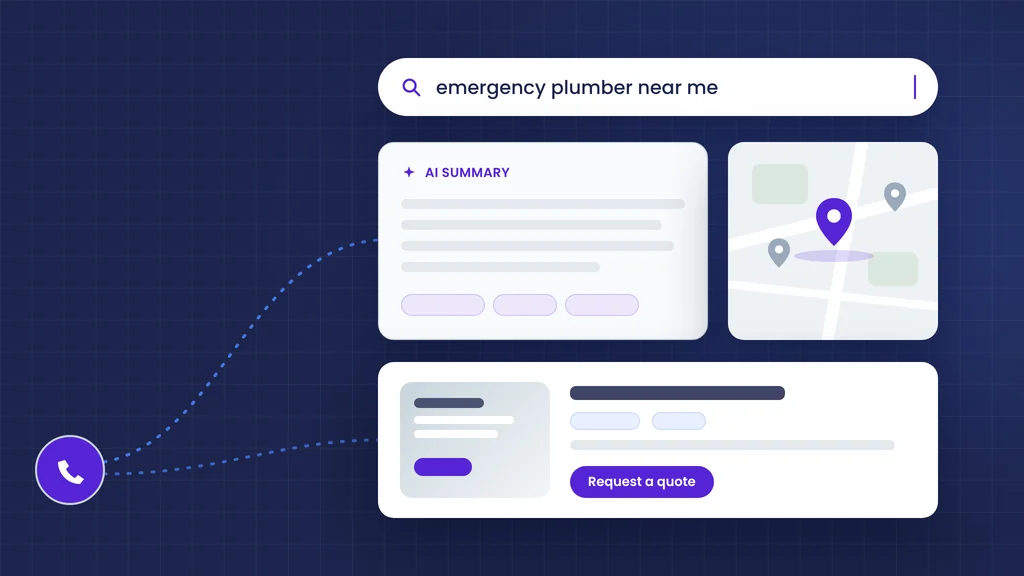
Why is SEO important when a customer can ask an AI tool, scroll through Maps, or click an ad instead? Because every one of those routes still depends on whether your business can be found and understood at the moment someone goes looking. Search engine optimization is the work that makes that more likely.
The short answer: SEO helps people find, understand, and evaluate your business while they are already searching for what you offer. It cannot guarantee a ranking or a sale. The right kind of SEO depends on how you sell: a business that meets customers in person usually needs its website and Google Business Profile working together, while an online-only business depends on its website. AI has changed where answers appear, but Google says the same SEO fundamentals sit underneath its AI features.
Most articles answering this question list ten or more benefits. This one starts with the problem small businesses actually report, shows you how to check what your own customers see, and is honest about when SEO should not be your first move.
Why is SEO important for small businesses?
Finding customers is a documented problem, not a marketing slogan. In the Federal Reserve Banks’ 2025 Report on Employer Firms, 57% of small employer firms said reaching customers and growing sales was an operational challenge in 2024, up from 53% in 2023. The survey drew 7,653 responses from firms with 1 to 499 employees.
Those businesses compete for attention in crowded markets. The SBA Office of Advocacy counts 36,207,130 small businesses in the U.S. In two of the markets we serve, its 2025 profiles count 3.5 million in Texas and 1.1 million in New Jersey, based on 2022 Census data.
Google’s own SEO Starter Guide describes SEO as “helping search engines understand your content” and helping users find your site and decide whether to visit it. It also says plainly: “There are no secrets here that’ll automatically rank your site first in Google.”
For a business owner, that translates into four jobs:
- Be found. Your pages and profile can appear when someone searches for what you do, where you do it.
- Be understood. Search systems and people can tell what you offer, who it is for, and where you work.
- Be chosen. Accurate details, honest reviews, and a clear next step give someone a reason to contact you.
- Be measured. You can see whether search is producing calls, inquiries, and customers, not just visits.
Notice what is missing: “rank number one.” A ranking is a means to those four jobs, and only one signal among many.
There is also a floor beneath all of it. Google’s explanation of how Search works says it “doesn’t guarantee that it will crawl, index, or serve your page,” even when the page follows its guidelines, and it “doesn’t accept payment to crawl a site more frequently, or rank it higher.” A service page Google has not indexed cannot be found through Google Search at all. Much of SEO is making sure your important pages clear that floor and then deserve to be shown.
See what your customers see
You do not need a tool to understand why SEO matters for your business. Spend fifteen minutes searching the way your customers do. Use a phone, because many of them will.
Results vary by location, device, and time, so treat this as a snapshot of the customer experience, not a ranking report.
- Search the short way. Type what a ready-to-buy customer would: your service plus “near me,” or your service plus your town. Check Google Search and Google Maps.
- Search the long way. Type a full question someone asks before they buy, such as what a repair costs or how to choose a provider. Note whether an AI summary appears and which websites it cites.
- Search your business name. Compare what your Business Profile shows with your website: hours, phone number, address or service area, and services.
- Read your own search data. In Google Search Console, the Performance report shows queries and impressions, defined as “how many times your site appeared in Search results.” Those queries are the words real people typed before seeing you. Few small businesses read them.
Step three matters more than it looks. Google says Business Profile information is compiled from several sources, including the business owner, users who contribute details, licensed third-party data, and crawled web content such as your official website. When those sources disagree, customers get mixed messages.
What you find tells you where to look first:
- Missing from short local searches? Your profile may be incomplete or a weak match for the search. Start with your Business Profile and service pages.
- Showing up with the wrong hours, phone, or area? Your business information is inconsistent. Check your profile, website, and directory listings.
- Other businesses answering your customers’ questions? Your website does not cover what buyers ask. Add or improve service pages and helpful articles.
- Appearing, but few people click? The listing does not explain why to choose you. Look at page titles, descriptions, reviews, and photos.
- Few impressions for your services in Search Console? Pages may be missing, unclear, or not indexed. Check indexing first, then the page content.
This is the same thinking behind a proper SEO audit, done from the customer’s side of the screen.
Website, Google Business Profile, or both?
Many SEO checklists tell every business to “optimize your Google Business Profile.” That advice does not fit everyone.
Google’s eligibility rules say: “To qualify for a Business Profile, a business must make in-person contact with customers during its stated hours.” Online-only businesses are on the ineligible list. A remote consultancy or an online store should put its effort into the website instead.
For businesses that do qualify, a profile and a website do different jobs. The profile shows practical details in Search and Maps. The website has room to explain services, answer questions, show evidence of your work, and measure what visitors do.
Website and Business Profile
Customers check practical details on your profile and decide on your website.
- Accurate category, hours, phone, and service area
- A clear website page for each main service
- The same business details everywhere
Fix the profile’s accuracy first, then strengthen your service pages.
Website first
You are not eligible for a Business Profile, so your website carries discovery.
- Pages Google can crawl and index
- Detailed service or product pages
- Content that answers buyers’ real questions
Invest in website content and the tracking that shows what it produces.
Either way, your website is the part you fully own and can measure.
If you travel to customers, configure your profile as a service-area business. Google’s guidelines say service-area businesses “should hide your business address from customers,” that a service area “shouldn’t extend farther than about 2 hours of driving time” from your base, and that a virtual office is not allowed unless it is staffed during business hours.
Local results follow different rules from ordinary web results. Google’s local ranking guidance says they mainly reflect how well a profile matches the search, how far the business is from the searcher, and how well-known the business is. It adds: “There’s no way to request or pay for a better local ranking on Google.” If you are not eligible for a profile, or not near the searcher, your website still matters for broader searches.
Our Local SEO service focuses on the profile-and-local side. Full-Service SEO covers the website, technical, and content work as well.
Does AI make SEO less important?
AI changes how some people search. It does not replace the need to be findable, and the evidence is more specific than most headlines.
What Google says. Its documentation on AI features states: “The best practices for SEO remain relevant for AI features in Google Search (such as AI Overviews and AI Mode).” To appear as a supporting link, a page must be indexed and eligible to show in Search with a snippet. Google adds: “You don’t need to create new machine readable files, AI text files, or markup to appear in these features.”
Its newer guide to generative AI features goes further: “optimizing for generative AI search is optimizing for the search experience, and thus still SEO.” It also says there is “no requirement to break your content into tiny pieces” for AI to understand it.
What independent research found. Pew Research Center analyzed the browsing of 900 U.S. adults who searched Google in March 2025:
- 18% of the searches produced an AI summary.
- When a summary appeared, people clicked a traditional search result on 8% of visits, compared with 15% when no summary appeared.
- People clicked a link inside the summary on 1% of visits.
- Browsing ended on 26% of pages with a summary, compared with 16% of pages with only traditional results.
The detail most articles skip is query length. In the same study, only 8% of one- or two-word searches produced an AI summary. For searches of ten words or more, it was 53%.
Our reading for local businesses. This is our interpretation, not Pew’s finding. Long, question-style searches were the most likely to show an AI summary. Customers ready to hire often type something short, like a service and a town. If that pattern holds for your customers, AI summaries are most likely to absorb clicks on general, educational questions, while short service searches lead to a more traditional results page. It is one month of data, and search products change quickly, so check your own searches rather than assuming.
Two practical points follow:
- Your measurement will blur AI and ordinary search. Google says appearances in its AI features are included in the overall search traffic in Search Console, under the Web search type. You cannot cleanly separate them there.
- Do not buy an “AI SEO” shortcut. Special files, invented markup, and keyword-stuffed answers are not what Google asks for. Pages that are indexable, specific, and based on real experience are.
In one of our own projects, an anonymous New Jersey dental clinic, we observed the clinic appearing as the first recommendation in ChatGPT for three query patterns. That is our own observation, not a controlled test, and AI assistants outside Google work in their own ways. What matters is the work behind it: an accurate Business Profile and consistent directory citations. There was no AI trick.
What SEO looked like in two of our projects
Industry articles tend to show SEO value as a single number. In practice, it looks different for each business. Here is what it looked like for two of our anonymous clients, with the limits of each result stated.
A New Jersey dental clinic: Local SEO only. The work was Google Business Profile optimization and directory citations. On the ranking grid for “dental implants,” the average position moved from 5.09 to 2.16, and top-three coverage rose from 29.59% to 96.45% of measured grid points between November 27, 2025 and January 14, 2026. Reported phone calls rose from 85 to 114, a 34% increase, across months the owner labeled January and February. Calls are not confirmed appointments, and grid points are not patients. Read the dental case study.
A prenatal imaging business: website and profile keyword strategy. Organic search brought 9,908 new users, up 45.4%, from December 1, 2024 to June 14, 2025, compared with the same dates a year earlier. Work began on December 15, 2024, so the window includes two weeks before it started. These are website users, not appointments. Read the prenatal imaging case study.
For one business, the value of SEO showed up as phone calls from a map. For the other, it showed up as new visitors from organic search. Neither result predicts yours. Both show why the goal needs defining before the work starts. More examples are on our case studies page.
Is SEO worth the investment?
SEO is often sold as “free traffic.” It is not free. It costs time, money, or both, and Google’s Starter Guide notes that some changes take effect within hours while others can take several months. That matters when budgets are tight: 75% of firms in the Federal Reserve survey said rising costs of goods, services, or wages were a financial challenge.
The long-term ROI of SEO comes from what the work leaves behind. A paid search ad stops showing when the budget stops. A clear service page or an accurate profile remains eligible to appear after the work is done. Eligibility is not a guarantee of traffic, which is why SEO is judged over months rather than weeks.
Paid search and SEO are not rivals. If you need inquiries sooner, Google Ads can bring them in while organic visibility builds, provided the economics work.
Before you set any SEO budget, know three numbers:
- What a new customer is worth to you in gross profit, not revenue.
- What share of inquiries become customers.
- How many more inquiries you could actually handle each month.
Those numbers tell you what a qualified inquiry is worth and how much you can sensibly spend to win one. They also keep you away from agencies that sell rankings without asking about your business.
When SEO shouldn’t come first
This is the part most guides leave out. SEO helps a viable business get discovered. It cannot fix the business itself. Put something else first when:
- You cannot handle the work you already get. More visibility only creates more disappointed callers.
- Inquiries go unanswered. Fix the phone, the inbox, and the follow-up before you pay to increase demand.
- The offer or price is the problem. SEO can bring the right people to a page, but it cannot make the offer competitive.
- Reviews describe a real service problem. Fix the operational cause first. Optimizing around it will not last.
- You need leads this month to cover costs. Paid channels may suit the short term better, with SEO as the longer-term asset.
- Your website breaks the inquiry. If the form fails or the page will not load on a phone, start there. Our guide to why a website is slow shows how to test that journey.
The Federal Reserve survey is a reminder that owners juggle more than visibility: 56% of firms cited paying operating expenses as a financial challenge, and 51% cited uneven cash flows. Search optimization does not directly fix those.
How to measure SEO beyond rankings
Rankings are a useful diagnostic. They are not the result. To measure SEO success, follow the chain from first sighting to paying customer.
- 01
Get found
Impressions and queries in Search Console, plus Business Profile views.
Check: are the right people seeing us?
- 02
Get chosen
Clicks to your website, and calls, website clicks, and direction requests from your profile.
Check: are they choosing us?
- 03
Get contacted
Form submissions, calls, and bookings recorded as key events in analytics.
Check: are they taking a real step?
- 04
Win the customer
Inquiries that became paying customers, tracked in a CRM or a simple lead log.
Check: did it become business?
Rankings help diagnose the first step. The business result is the last one.
Know what each tool can and cannot tell you:
- Search Console reports clicks, impressions, click-through rate, and average position by query, page, country, and device. It describes visibility, not sales.
- Your Business Profile performance report counts calls as “the number of times a customer clicked on the call button on your Business Profile.” A tap on the button is not a completed call or a booked job.
- Google Analytics lets you mark an event as a key event “if an event is important to your business’s success,” such as a submitted inquiry.
- Your own records close the loop. Ask new customers how they found you, and log it. No tool proves that one search caused one sale, especially when customers call or visit in person.
Your first 30 days
A practical action plan, one focus per week:
Week 1: Make sure you can be found. Set up Google Search Console and check that your main service pages are indexed. List the three to five pages that matter most to your revenue.
Week 2: Improve one service page. Rewrite your most important service page around what customers ask: who it is for, what is included, where you work, what happens after they contact you, and how to reach you. Google’s guidance on helpful content says it has no preferred word count, so aim for usefulness, not length.
Week 3: Fix your profile and reviews. If you are eligible, check your Business Profile’s category, hours, phone, website link, and service area against your website. Ask recent customers for honest reviews. The FTC’s Consumer Reviews and Testimonials Rule took effect on October 21, 2024. Its staff guidance says incentives are not prohibited as long as they do not require a particular sentiment, but asking only customers you expect to be happy could violate the FTC Act.
Week 4: Decide what counts. Choose the actions that matter, such as a submitted inquiry, a booking, or a call. Set them up as key events, and start a simple log of where new customers came from.
These are quick wins, but they are also the foundation. Most of what follows in SEO is more of the same, done consistently.
Do it yourself or hire an agency?
Many owners can handle the first 30 days themselves. Doing it yourself works well when you have one location, a few hours a month, and a website you can edit.
Working with an agency makes more sense when time is the constraint, technical problems keep blocking progress, or you compete in several services or areas. Whoever you consider, ask:
- What will you do in the first 90 days, and why in that order?
- How will you report progress? Look for calls, inquiries, and customers, not only rankings.
- Who owns the website, content, and profile access if we stop working together?
Treat these as red flags: guaranteed rankings, offers to buy or write reviews, “AI optimization” packages built on special files or markup, and reports that only show positions.
At Ranking Assist, we start with how your business wins customers and tell you if SEO is not the first thing to fix. If it is, our digital marketing services cover Local SEO, Full-Service SEO, Google Ads, and website design.
This week, run the fifteen-minute customer search above. Write down where you were missing, where your details disagreed, and which questions other businesses answered instead of you. Then send us what you found. It gives us a concrete starting point for a strategy call.
Keep reading
Why is my website so slow? Find what’s costing you inquiries
A practical guide for service-business owners: find the delay your customers experience, give your developer a useful brief, and choose the right fix.
PHP cyber-security update: The National Security Agency warning for WordPress
WordPress businesses need to act on the PHP warning. See the immediate checks to make and how a PHP-free Ranking Assist website changes the longer-term picture.